
Artificial Turf Football Pitch Construction in the UAE: FIFA Quality, Shock Pads, Infill and Heat
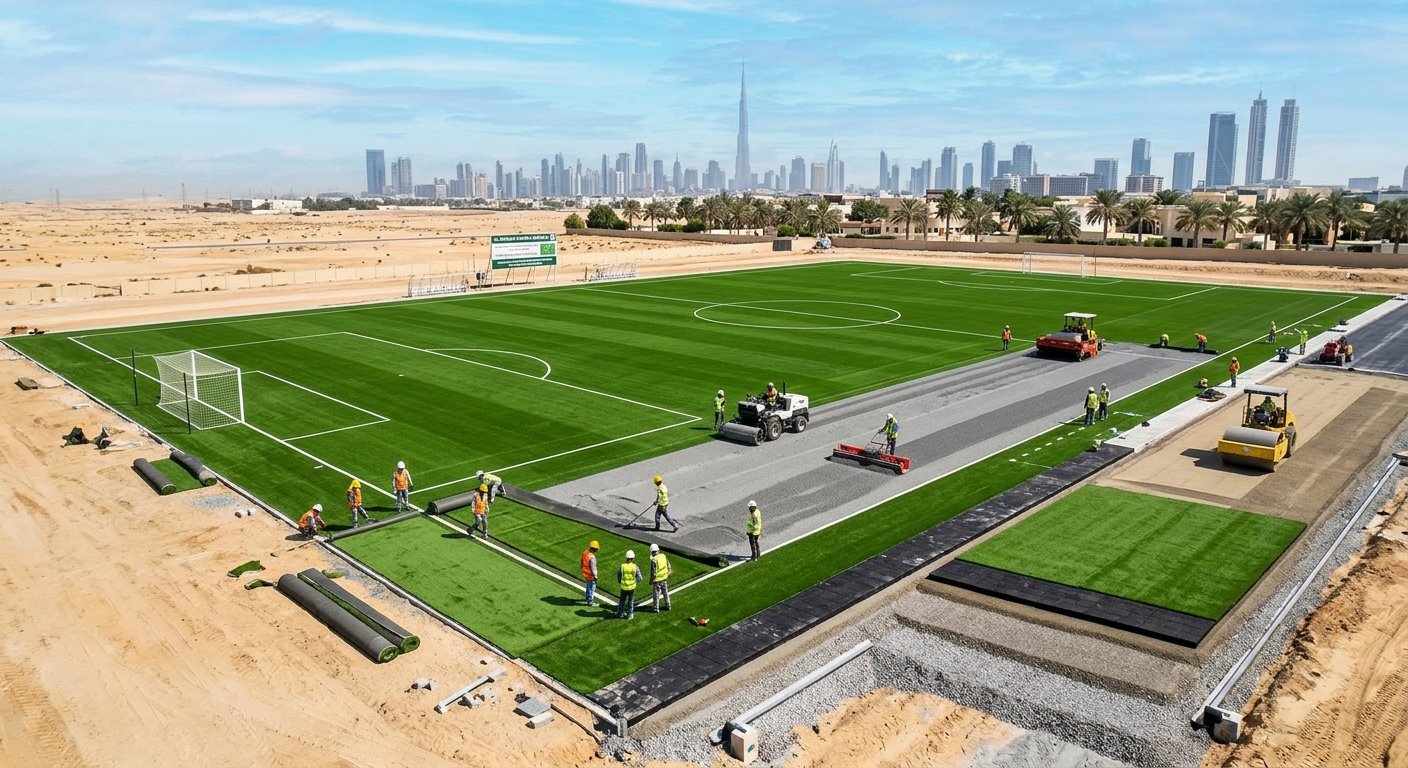
An artificial turf football pitch in the UAE is a layered system: an engineered and drained sub-base, a shock pad, the turf carpet and an infill that keeps fibres upright and controls how the ball rolls and how the surface feels underfoot. Get the bottom layers right and the turf can be replaced on the same base for decades. Get them wrong and no turf will save the pitch. Most owners shop for the carpet. Fibre colour, pile height, a sample that feels soft in the showroom. We understand why. But when we’re called to inspect a failing pitch in Dubai or Sharjah, the problem is rarely the fibre. It’s water sitting under the surface, a sub-base that has settled, or infill that has migrated into the corners and left bald patches in the goalmouth.
What is a FIFA Quality pitch?
The FIFA Quality Programme for Football Turf tests synthetic pitches against measurable performance criteria and has two levels: FIFA Quality and the stricter FIFA Quality Pro. Tests cover how the ball bounces and rolls, shock absorption, how much the surface gives underfoot and rotational resistance, which is how much grip a boot gets when a player turns.
Do you need certification? For professional and federation-level competition, often yes. For a school, an academy or a commercial 5-a-side centre, a turf system that has been tested to FIFA Quality criteria gives you the same safety and playing benefits without the cost of certifying every pitch. Tell your contractor which level of competition the pitch will host before they specify anything.
The layers, from the ground up
Sub-base and drainage. UAE soils range from loose dune sand to compacted fill and sabkha near the coast. We survey and test before design. A typical build has an excavated and compacted formation, a geotextile, a free-draining stone layer and, on larger pitches, lateral drains to a collection point. Rain is rare here, but irrigation water used for cooling isn’t, and neither are the occasional winter downpours that flood badly drained pitches for days.
Shock pad (e-layer). A shock pad sits under the turf and does much of the work of absorbing impact. That means the pitch can use less rubber infill and still meet shock-absorption targets. A good pad often outlasts two turf carpets, which makes it one of the best long-term investments in the build.
Turf carpet. Football turf is usually 40–60mm pile, with monofilament or fibrillated fibres or a mix. In our climate the spec that matters most is UV stabilisation. Ask for the fibre’s UV test data and the warranty conditions in writing.
Infill. Usually a stabilising layer of silica sand with a performance infill on top.
Choosing infill: rubber, coated sand or organic?
SBR rubber granules are the traditional performance infill. They’re cheap and they work, but they get very hot in direct sun. EPDM and coated granules cost more, look better and stay more consistent. Organic infills such as cork or coconut fibre run cooler and are gaining ground, especially since the European Union adopted a restriction on intentionally added microplastics in 2023 that phases out loose polymer infill there by 2031.
The UAE isn’t bound by EU rules. But global turf manufacturers are redesigning products around them, so infill-light and organic systems will become more common here over the life of a pitch you build today. We’re happy to specify either and explain the trade-offs on your site.
Heat: the UAE’s biggest turf challenge
Stand on an artificial pitch at 2pm in August and you’ll feel it through your shoes. Synthetic turf surfaces can run tens of degrees hotter than the air in full sun. That isn’t a defect. It’s physics.
You manage it in four ways: schedule play for mornings and evenings, specify heat-reflective fibre technologies and cooler infills, use irrigation to cool the surface before sessions, and add shade or a canopy over smaller pitches. For a 5-a-side or 7-a-side centre, a covered pitch can transform summer revenue.
Pitch sizes we build
| Format | Typical size | Common use |
|---|---|---|
| 5-a-side | About 30–40m × 20m | Commercial centres, schools, villas |
| 7-a-side | About 50–65m × 30–45m | Academies, community clubs |
| Full size | 105m × 68m recommended | Clubs, stadiums, universities |
Full-size dimensions follow the Laws of the Game, and FIFA recommends 105m × 68m. Add run-off around the field of play in every case.
How long does an artificial football pitch last?
A well-maintained turf carpet typically lasts eight to ten years under normal use, less on a pitch booked 12 hours a day. The sub-base and drainage, if built properly, last far longer and can take a new carpet without major civil works. That’s the real reason to invest in the bottom layers.
Maintenance is what decides the number. Weekly brushing keeps fibres upright and infill even. Periodic decompaction stops the infill setting hard. Infill top-ups replace what players carry off in their boots. We cover this in our maintenance plans.
You can see what’s included in our football field construction service, from turf systems and shock pads to goals and dugouts, and browse finished pitches including Joker Stadium in Dubai on our projects page.
Frequently asked questions
1. What is the difference between FIFA Quality and FIFA Quality Pro?
Both are levels of the FIFA Quality Programme. Quality Pro has tighter performance limits and is typically required for higher-level competition.
2. Do I need a FIFA-certified pitch?
Only if a competition or federation requires it. Schools and commercial centres usually choose a FIFA Quality-tested turf system without certifying each pitch.
3. How long does it take to build an artificial football pitch?
A 5-a-side pitch can take a few weeks. A full-size pitch with drainage and a shock pad usually takes two to four months, depending on the site.
4. Is a shock pad necessary?
It isn’t always mandatory, but we recommend it. It improves safety, reduces the amount of rubber infill needed and often lasts through two turf carpets.
5. Why does artificial turf get so hot in the UAE?
The fibres and infill absorb solar radiation. Heat-reflective fibres, cooler infills, irrigation and shade all reduce surface temperatures.
6. What is the best infill for UAE football pitches?
It depends on use and budget. SBR is economical, coated and EPDM granules are more consistent, and organic infills run cooler. We advise per site.
7. How long does artificial football turf last?
Typically eight to ten years with good maintenance. Heavy use shortens that.
8. Can artificial turf be laid on an existing sand pitch?
Not directly. The site needs an engineered, compacted and drained base first.
9. What size is a 5-a-side football pitch?
There’s no single fixed size, but most commercial 5-a-side pitches are about 30–40m long and 20m wide, plus run-off.
10. Does Forsan supply goals and dugouts?
Yes. We supply and install goals, nets, dugouts, fencing and line marking as part of a turnkey pitch.