
Outdoor Basketball Court Flooring in the UAE: Acrylic vs Modular Tiles
Quick answer: Choose a cushioned acrylic system if you want the best ball bounce, a seamless look and the longest life on a well-built concrete or asphalt base. Choose modular polypropylene tiles if you need a fast installation, a court on an imperfect existing slab, or a surface you can lift and relocate. For most schools and communities in the UAE, cushioned acrylic is our default. Walk onto two outdoor courts in Dubai on the same evening and you can often tell the surfaces apart with your eyes closed. One sounds solid when the ball hits. The other has a faint hollow click. That sound tells you most of what you need to know about how they play.
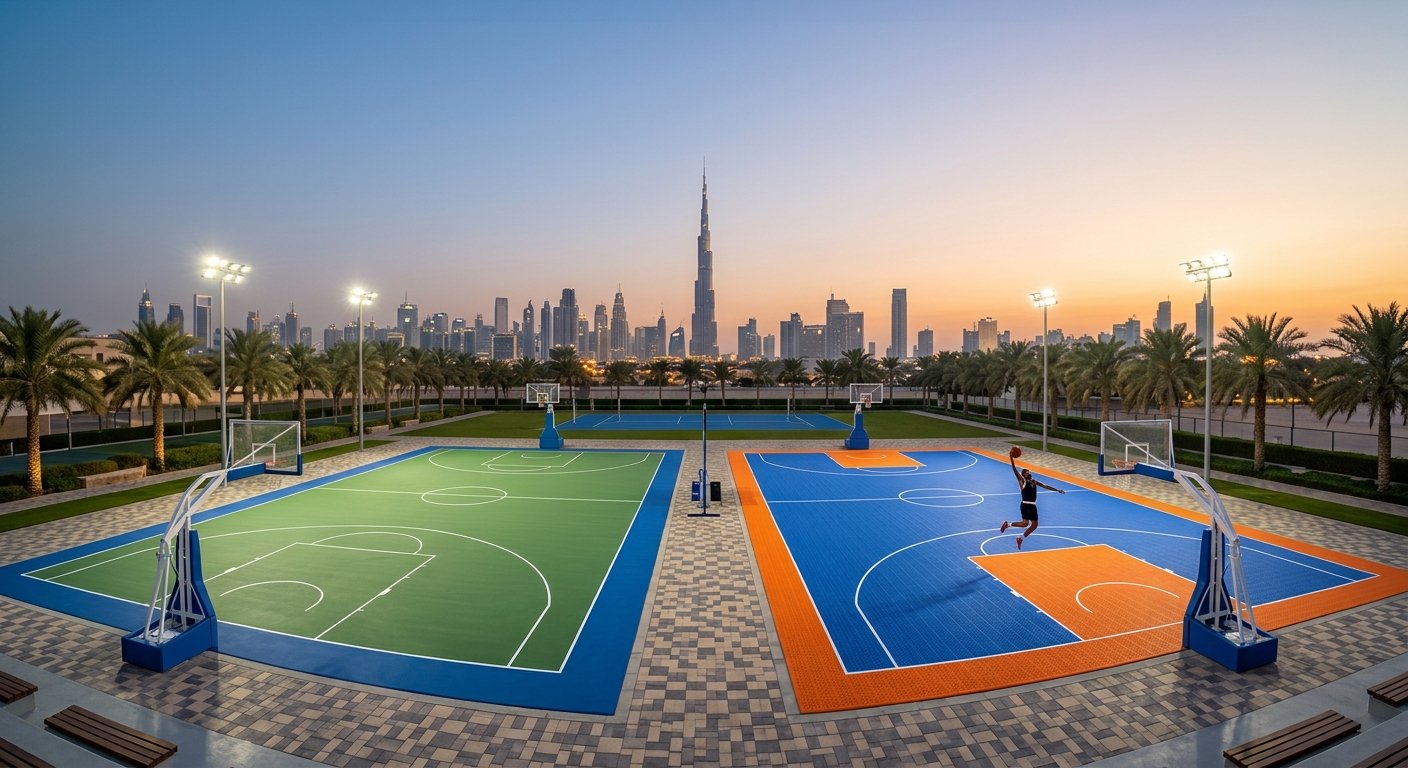
Acrylic vs modular tiles at a glance
| Factor | Cushioned acrylic | Modular PP tiles |
|---|---|---|
| Ball bounce | Very consistent | Good, can vary slightly at joints |
| Feel underfoot | Firm with cushion layers | Firm, slight give |
| Drainage | Surface fall to edges | Water drains through the tiles |
| Installation | Needs a sound, level slab and curing | Fast, tolerant of minor slab flaws |
| Heat | Hot in direct sun, lighter colours help | Hot in direct sun, can expand |
| Repairs | Patch and recoat | Replace individual tiles |
| Typical recoat or replace | Recoat every 4–8 years | Tiles often last 10+ years |
How acrylic basketball courts are built
An acrylic court is a series of thin layers on top of a concrete or asphalt base. A resurfacer fills the texture of the base. Cushion layers of rubber-modified acrylic add comfort and reduce joint fatigue. Colour coats give the finish and the grip, and line paint goes on last.
All of it is only millimetres thick, which is why the base matters so much. Acrylic shows every crack, dip and ridge underneath. On new builds we pour a reinforced slab with control joints planned around the court markings. On refurbishments we repair cracks and fill depressions before any coating.
How modular tile courts work
Modular tiles are interlocking polypropylene squares, typically about 30cm × 30cm, that snap together on top of the slab. Many have a perforated top so water drains straight through. They can go down in a day or two on a small court.
The UAE-specific issue is thermal expansion. Plastic grows in the heat. Good tile systems include expansion allowances at the edges and joint designs that cope with it. Cheap tiles laid tight edge to edge in January can buckle in July. We’ve replaced more than one court where that happened.
Heat and colour on outdoor courts
Every outdoor surface here gets hot in the afternoon. The practical levers are the same for both systems. Lighter colours stay cooler. Shade structures make the biggest difference. LED lighting moves play into the evening, when most people want to use the court anyway.
If you’re choosing colours, remember that ball and line visibility matter more than looks. An orange ball on a red court is harder to track under floodlights than on blue or green.
Court sizes
A full FIBA basketball court is 28m × 15m, plus run-off around the lines. For 3x3 basketball, FIBA uses a half court of 15m × 11m. Many villa and school courts are smaller multi-use “key” courts with one hoop.
Thinking of combining sports? An acrylic court can carry lines for basketball, tennis and volleyball. Too many lines confuse players, so pick a main sport and keep the others in a lighter colour.
Which should you choose?
Cushioned acrylic wins for schools, residential communities and clubs that want a permanent court with a premium feel and the best bounce. Modular tiles win for temporary venues, rooftops where weight and drainage matter, multi-use games areas on existing slabs and projects with very short programmes.
Our basketball court construction service covers both systems plus hoops, lighting and fencing. For a wider comparison that includes PU and EPDM, read our guide to sports flooring solutions in the UAE.
Frequently asked questions
1. What is the best flooring for an outdoor basketball court in the UAE?
Cushioned acrylic on a sound concrete or asphalt base gives the best overall performance for permanent courts.
2. Are modular tiles good for basketball?
Yes for recreational and multi-use courts. Bounce is slightly less uniform than acrylic, but installation is fast and drainage is excellent.
3. How long does an acrylic basketball court last?
The base lasts many years. The acrylic top typically needs recoating every four to eight years depending on use and sun exposure.
4. Can modular tiles be installed on an old cracked court?
Often yes, as long as the slab is stable and reasonably level. Large cracks and dips should still be repaired.
5. What size is a full basketball court?
A FIBA court is 28m × 15m, plus safety run-off.
6. Do outdoor courts get too hot to play on?
In direct summer sun, yes. Shade, lighter colours and evening play under LED lighting solve most of the problem.
7. Can a basketball court also be used for tennis or volleyball?
Yes. Acrylic courts can carry multiple line sets. Keep the main sport’s lines most visible.
8. Does an acrylic court need a concrete base?
Concrete or asphalt both work, but the base must be level, sound and cured before coating.
9. Why do some tile courts buckle?
Usually because they were laid without enough expansion allowance. Plastic tiles expand significantly in UAE summer heat.
10. Does Forsan supply basketball hoops?
Yes. We supply and install fixed and adjustable hoop systems, backboards and nets with every court.