
Classic vs Panoramic vs Super-Panoramic Padel Courts: Which One Should You Build?
Quick answer: Choose a classic court if you want the best value and the court is for private or training use. Choose a panoramic court if you run a commercial club and spectators matter. Choose a super-panoramic court for a flagship or tournament venue where every side must be unobstructed. All three play to the same 20m × 10m FIP dimensions. The difference between them is almost entirely about where the steel goes. Ball bounce, turf and court size don’t change. What changes is how much of the court a spectator, a camera or a player can see without a post in the way, and how much the structure has to do to hold glass up without those posts.
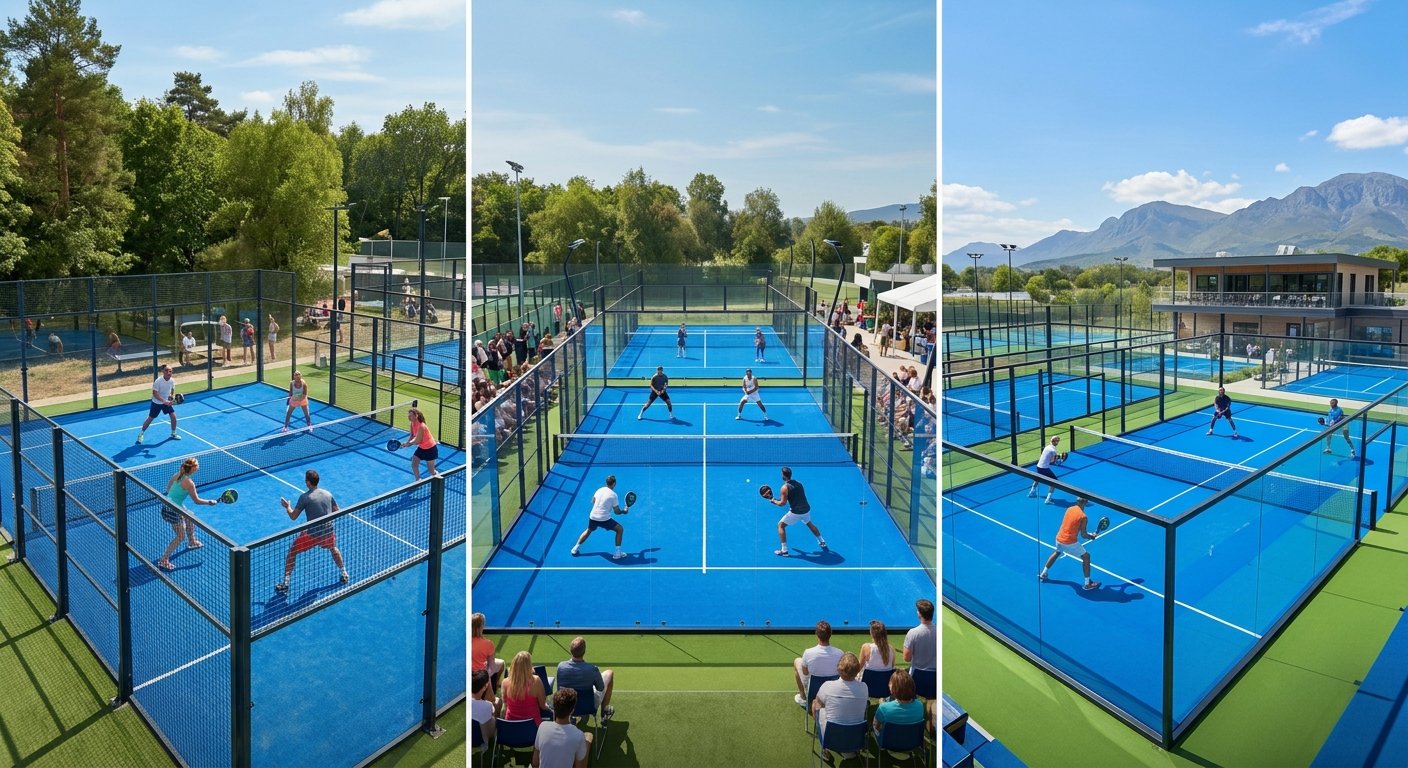
At a glance
| Feature | Classic | Panoramic | Super-panoramic |
|---|---|---|---|
| Back-wall posts | Visible between glass panels | Removed, glass held by clamps | Removed |
| Side-wall posts | Visible | Usually visible | Removed or minimised |
| Spectator view | Good | Very good from the ends | Unobstructed on all sides |
| Relative structure cost | Base | About 30–50% more | Highest |
| Best for | Villas, schools, training | Commercial clubs | Flagship and event courts |
What makes a padel court “panoramic”?
A panoramic padel court is one where the steel posts on the back walls are moved outside the glass, so the back walls are uninterrupted panes. The glass is held by clamps and the load runs into a reinforced frame behind and around it. That’s it. It’s an engineering choice about load paths, and it has big consequences for how the court looks.
On a classic court, posts sit between every glass panel. They’re structurally simple and cheap to make. They also put a vertical steel line across a spectator’s view every two metres.
A super-panoramic court goes further and strips the posts from the side walls too, typically using heavier perimeter structures and corner glass. From the stands, it looks like four sheets of glass and a net.
Does the court type change how padel plays?
Barely. The ball comes off glass the same way whether a post is behind it or not, as long as the glass is the right thickness and properly tensioned. Where players notice a difference is in rebounds near the posts on cheap classic courts, where a badly fitted panel can “deaden” the bounce. That’s a build-quality problem, not a design problem.
One thing players do notice: depth perception. Some club players say panoramic courts feel more open, which can make the back glass harder to judge for the first few sessions. Most adjust within a week.
The UAE factor: wind, heat and sand
This is where the choice gets local. Full-glass walls act like a sail. On an exposed outdoor site, a super-panoramic court must be engineered for wind load properly, because there are fewer posts to share it. We check wind exposure on every outdoor survey, especially on beachfront and open desert plots.
Heat matters too. Glass and steel expand at different rates, and a July afternoon in Abu Dhabi can push surface temperatures well above air temperature. Good clamp systems allow for that movement. Cheap ones crack glass at the corners.
And sand. Mesh panels on classic courts let wind-blown sand through more freely. Full-glass walls trap more of it on the turf, so panoramic courts in open locations need more frequent brushing. Not a reason to avoid them. Just a reason to budget maintenance.
K-type and wall-type panoramic options
We build two common panoramic layouts. K-type structures use angled external supports, which keep the playing area clear and suit open sites with space behind the court. Wall-type structures sit tighter to the court edge, which helps on rooftops, between buildings or where the plot is tight. The right one depends on your footprint, not on preference.
Which court type should you choose?
Private villa owners: classic, almost always, unless the court is a centrepiece of the garden and you want the glass look. You’ll save a large share of the structure cost with no loss in play.
Commercial clubs: panoramic. Players paying AED 300+ for a peak slot in Dubai expect it, and it photographs better for your marketing.
Tournament and flagship venues: super-panoramic, at least for the show court. Many clubs build one super-panoramic centre court and panoramic courts around it.
You can review the full structure, glass and lighting specification on our padel court service page, and see completed panoramic builds such as the ACTIVE Al Maryah courts in Abu Dhabi on our projects page.
Frequently asked questions
1. What is the difference between a panoramic and a super-panoramic padel court?
A panoramic court removes the posts from the back walls. A super-panoramic court also removes or minimises posts on the side walls, giving clear views from every angle.
2. Are panoramic padel courts FIP-approved?
Court dimensions and glass specifications are what FIP rules govern. Panoramic and super-panoramic courts built to the 20m × 10m layout with the right glass and wall heights meet the same playing requirements as classic courts.
3. Is a panoramic court better for players?
It plays the same. The main benefits are for spectators, cameras and the look of the venue.
4. How thick should padel court glass be?
We use 12mm tempered safety glass. Some courts use 10mm. Thicker glass gives more safety margin, especially on panoramic designs where glass carries more of the visual load.
5. Can a classic court be upgraded to panoramic later?
Not economically. The structure is different, so an upgrade usually means replacing the frame and glass. The slab and lighting can often be reused.
6. Are super-panoramic courts safe in strong wind?
Yes, if they’re engineered for the site’s wind load. That’s why an outdoor site survey matters more for super-panoramic courts than for classic ones.
7. Which padel court type is best for a villa?
A classic court gives the best value for private use. Choose panoramic if the court is a design feature visible from the house.
8. What is a K-type padel court?
It’s a panoramic structure with angled external supports. It keeps the playing area clear and suits sites with space around the court.
9. Do panoramic courts need more maintenance?
Slightly more glass cleaning and, on open sites, more turf brushing because glass walls trap blown sand. Structural maintenance is similar.
10. How long does it take to install a panoramic padel court?
Once the slab is ready and cured, structure, glass, turf and lighting usually take two to four weeks, depending on the number of courts.