
Running Track Construction in the UAE: Full PU vs Sandwich vs SBR Systems Compared
Quick answer: Choose a full PU (cast polyurethane) track for competition venues and elite clubs, a sandwich system for schools and universities that want near-competition performance at lower cost, and an SBR system with a spray-coat finish for community parks and jogging loops. All three need a stable, accurately levelled asphalt or concrete base. A running track is a long, thin structure exposed to the harshest sun in the country. Every metre of it sees the same heat cycle, the same UV, the same blown sand. So the question isn’t only “which system performs best?” It’s which system keeps performing after eight UAE summers on your site, with your level of use and your maintenance budget.
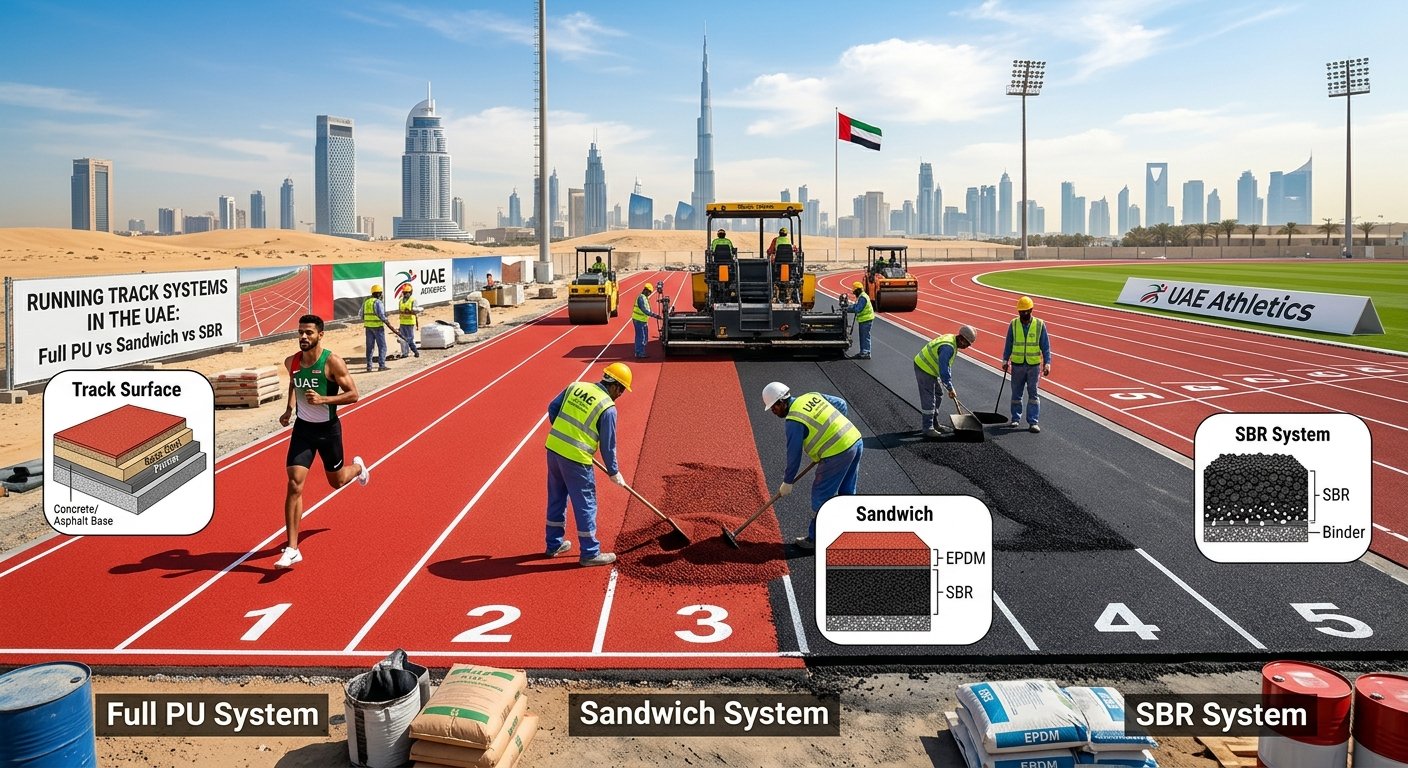
The three main track systems
| System | How it’s built | Best for | Typical life before resurfacing |
|---|---|---|---|
| Full PU | Poured polyurethane, often with EPDM granules on top | Competition stadiums, elite clubs | 12–15+ years |
| Sandwich | SBR rubber base mat, sealed, PU layer with EPDM granules | Schools, universities, club tracks | About 10–12 years |
| SBR + spray coat | SBR rubber base bound with PU, with a sprayed PU/EPDM texture | Parks, community and jogging tracks | About 6–8 years |
Lifespans are indicative. Heavy use, spiked shoes and poor maintenance shorten them. Regular cleaning and a timely top-coat extend them.
Full PU: the competition choice
A full PU track is cast in place as a solid layer of polyurethane. It’s non-porous, very consistent from lane 1 to lane 8 and the most durable under spikes. Athletes get predictable energy return. Facility managers get a surface that can be re-coated rather than rebuilt when the top wears.
It costs the most, and it needs a good base because it will faithfully reproduce any dips beneath it.
Sandwich systems: the sensible middle
A sandwich system puts a resilient SBR rubber base mat down first, seals it, then pours a PU wearing layer and broadcasts EPDM granules into it. You get much of the feel and durability of full PU at a lower price, because the rubber base provides the bulk of the thickness.
For most UAE schools that host inter-school athletics, this is the system we recommend. It handles spikes, it looks right and it lasts.
SBR with spray coat: for parks and jogging
The base is the same type of SBR mat, but the finish is a sprayed texture rather than a poured layer. It’s porous, so rainwater and irrigation drain through. It’s also the most economical option and the easiest to resurface. The trade-off is lower durability under spikes, which matters less on a community loop where people run in trainers.
What World Athletics standards mean for your track
The international body formerly known as the IAAF was renamed World Athletics in 2019. Its Track and Field Facilities Manual sets the layout of a standard 400m track, including lane width of 1.22m, and its product certification system tests surfaces for performance. Competition surfaces must be at least 13mm thick in most areas, with more in high-wear zones such as the jumps run-ups and steeplechase.
If you want to host certified competitions, you need a certified product installed to the manual and, for some levels, a facility certification survey. If you don’t, building to the same dimensions and markings still pays off, because it lets coaches and athletes train exactly as they’ll compete.
The base: where most track problems start
We’ve seen beautiful surfaces ruined by bad bases. Water ponding in lane 4 after irrigation. A visible ripple on the back straight that nobody noticed until the surface went down. Cracks reflecting up from an old slab.
Asphalt is the most common base for outdoor tracks. It must be laid to tight tolerances, with the correct cross-fall so water runs off, and it must be allowed to cure before the surface goes on. In summer, that curing window and the temperature at which resins are applied need careful scheduling. Rushing either is the fastest way to bubbles and delamination.
Heat, UV and colour
Track surfaces in the UAE get extremely hot in direct sun, and darker colours run hotter. Red is traditional. Blue, green and lighter tones are increasingly popular in Gulf schools, partly for looks and partly for slightly lower surface temperatures. Whatever the colour, insist on UV-stable resins and EPDM granules rated for high temperatures. We formulate for ambient temperatures above 50°C.
Compare systems in more detail on our running track service page, and see how track surfaces relate to the other systems we install on our sports flooring page.
Frequently asked questions
1. What is the best running track surface for a UAE school?
A sandwich system usually gives the best balance of performance, durability and cost for school athletics.
2. What is the difference between full PU and sandwich tracks?
Full PU is solid poured polyurethane throughout. A sandwich system uses an SBR rubber base mat under a PU wearing layer, which lowers cost.
3. How thick is a synthetic running track?
Competition tracks are at least 13mm in most areas, thicker in high-wear zones. Our systems start at 13mm and can be built thicker.
4. Is IAAF the same as World Athletics?
Yes. The IAAF was renamed World Athletics in 2019. Older specifications still use the IAAF name.
5. How long does a running track last in the UAE?
Roughly 6–8 years for SBR spray systems, 10–12 for sandwich systems and 12–15+ for full PU, with good maintenance.
6. Can an old running track be resurfaced?
Often yes. If the base is sound, a worn track can be cleaned, repaired and re-coated instead of fully replaced.
7. What base does a running track need?
Usually asphalt, laid to tight level tolerances with correct cross-fall and allowed to cure before surfacing. Concrete is used in some cases.
8. How wide is a running track lane?
A standard competition lane is 1.22m wide.
9. Do running tracks get hot in summer?
Yes. Darker colours get hotter. UV-stable materials, lighter colours and scheduling training for cooler hours all help.
10. How long does it take to install a running track?
The surfacing on a prepared base typically takes a few weeks for a standard 400m track, but base construction and curing come first. We confirm the programme after site survey.