
Indoor vs Beach Volleyball Court Construction in the UAE: Sizes, Surfaces and Sand
An indoor volleyball court is 18m × 9m on a shock-absorbing sports floor, inside a hall with at least 7m of clear height. A beach volleyball court is 16m × 8m on at least 40cm of clean, fine sand over a drainage layer. Both need a free zone around the court, and that free zone is where most space plans go wrong. We get asked about volleyball by two very different clients. Schools and sports halls who need an indoor court that also hosts basketball, futsal and assemblies. And hotels, beach clubs and residential communities who want a beach court that looks good on Instagram and actually plays well. The engineering is completely different.
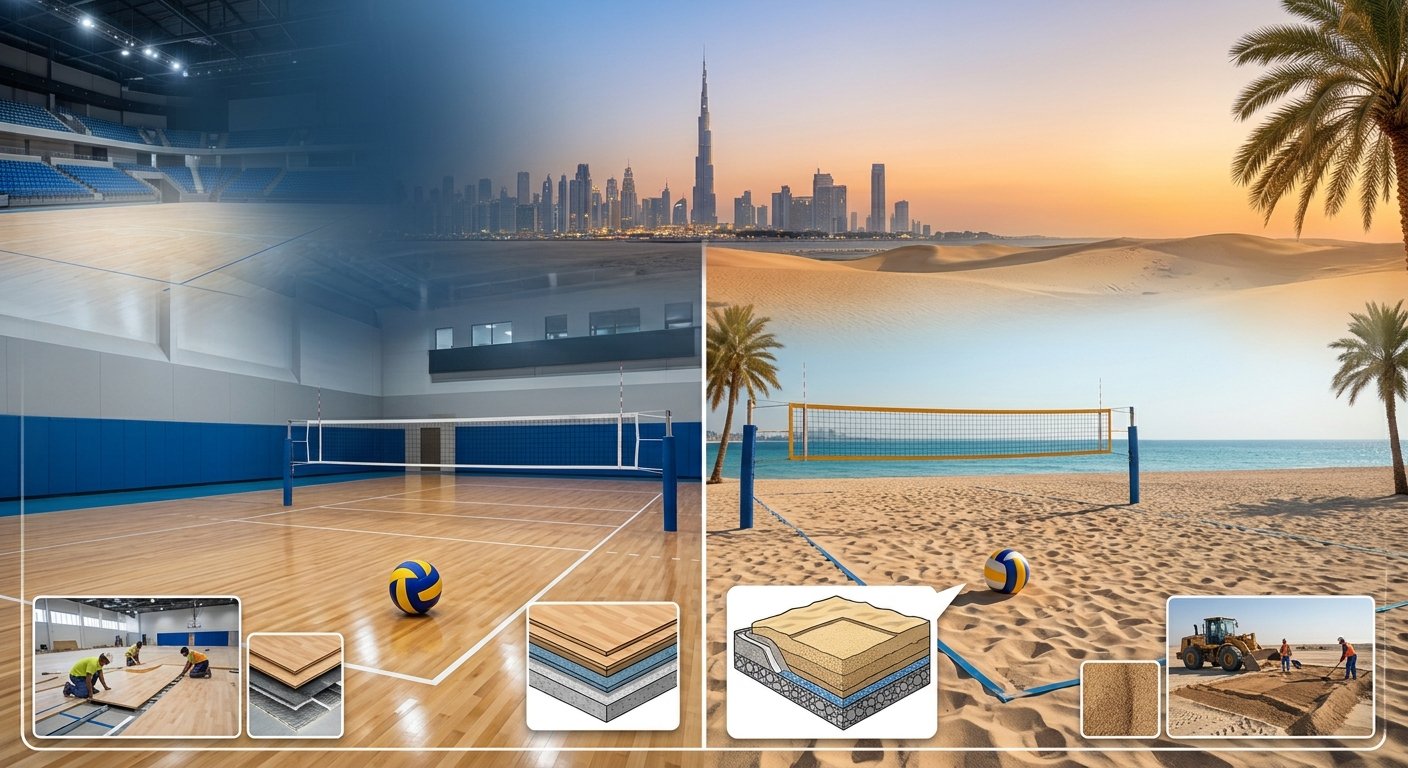
Volleyball court dimensions at a glance
| Spec | Indoor | Beach |
|---|---|---|
| Court size | 18m × 9m | 16m × 8m |
| Minimum free zone | 3m on all sides | 3m on all sides |
| FIVB competition free zone | 5m sides, 6.5m ends | 5–6m |
| Clear height | 7m minimum, 12.5m for FIVB events | Open sky, no obstructions |
| Net height | 2.43m men, 2.24m women | 2.43m men, 2.24m women |
The practical footprint for a recreational indoor court is about 24m × 15m. For a beach court, about 22m × 14m.
Indoor courts: the floor decides the game
Volleyball is a jumping sport. Players land hundreds of times a match, and they dive. The floor needs shock absorption for knees and ankles, a surface that isn’t abrasive for diving players and enough grip for sharp lateral moves.
We typically install point-elastic or combined-elastic polyurethane systems tested to EN 14904, the European standard for indoor sports surfaces. Sports vinyl rolls and timber floors also work. For FIVB-level competition, the federation approves specific synthetic floor products, so check that list if you plan to host official events.
In a multi-sport hall, volleyball rarely gets the floor to itself. Basketball, badminton and futsal lines will share it. We set out line colours so volleyball players aren’t distracted by six other sports at once.
Hall details people forget
Ceiling height catches out more indoor projects than anything else. A ball hitting a beam or a light fitting is a fault and a stoppage. Seven metres is the absolute minimum. More is better, and nothing should hang into that space.
Lighting must be bright and glare-free from below, because players look up constantly. Wall padding behind the free zone, sleeves for net posts set into the floor and protective padding on posts finish the job.
Beach courts: it’s all about the sand
Not all sand is volleyball sand. UAE desert sand is often too fine and dusty, and local beach sand can contain shells and silt. Good volleyball sand is washed, rounded and free of stones, shells and fine dust, so it’s soft to land on, doesn’t compact hard and doesn’t stick to sweaty skin.
Under the sand sits the part nobody sees. A geotextile separation layer, a gravel drainage layer and, in larger courts, perforated drain pipes. Without drainage, irrigation water and the occasional winter storm turn the court into a puddle with a crust.
Depth matters too. We build to at least 40cm of playing sand, which is the FIVB guideline. Shallower sand lets players feel the base when they dig for a ball.
Beach volleyball in the UAE climate
Sand surface temperatures in July afternoons are punishing. Beach courts here are mostly played early morning and after sunset, so floodlighting is essential, not optional. Light-coloured sand reflects more heat than darker sand, and light watering before play cools the top layer and controls dust.
For hotels and clubs, a perimeter of shade and seating around the court turns it into a social space rather than a patch of sand with a net.
Which court should you build?
If your venue already has a sports hall, an indoor court on a good PU floor gives year-round play and shares space with other sports. If you have outdoor space near a pool, beach or community park, a beach court is cheaper to build than a hall and becomes an attraction in its own right.
See what we deliver on our volleyball court construction page. For indoor courts inside multi-sport halls, our sports hall build and maintenance service covers flooring, equipment and ongoing care.
Frequently asked questions
1. What are the dimensions of a volleyball court?
An indoor court is 18m × 9m. A beach court is 16m × 8m. Both need a free zone of at least 3m around the court.
2. How high should a sports hall ceiling be for volleyball?
At least 7m clear height above the court. FIVB events require 12.5m.
3. What is the best flooring for indoor volleyball?
A shock-absorbing PU sports floor tested to EN 14904 is a strong choice. Timber and sports vinyl are also used.
4. How deep should sand be on a beach volleyball court?
At least 40cm of clean playing sand, over a drainage layer.
5. Can I use local sand for a beach volleyball court?
Usually not without testing. Much local sand is too fine, dusty or full of shells. Washed, graded volleyball sand performs far better.
6. What is the net height for volleyball?
2.43m for men and 2.24m for women, for both indoor and beach volleyball.
7. Does a beach volleyball court need drainage?
Yes. A gravel drainage layer and, on larger courts, drain pipes stop water ponding after irrigation or rain.
8. Can a volleyball court share space with basketball?
Indoors, yes. Most multi-sport halls mark volleyball, basketball and badminton on one floor.
9. How much space do I need for a beach volleyball court?
About 22m × 14m including a 3m free zone. More if you add seating.
10. Do beach volleyball courts need lighting in the UAE?
In practice, yes. Much of the year, the most comfortable playing hours are after sunset.